

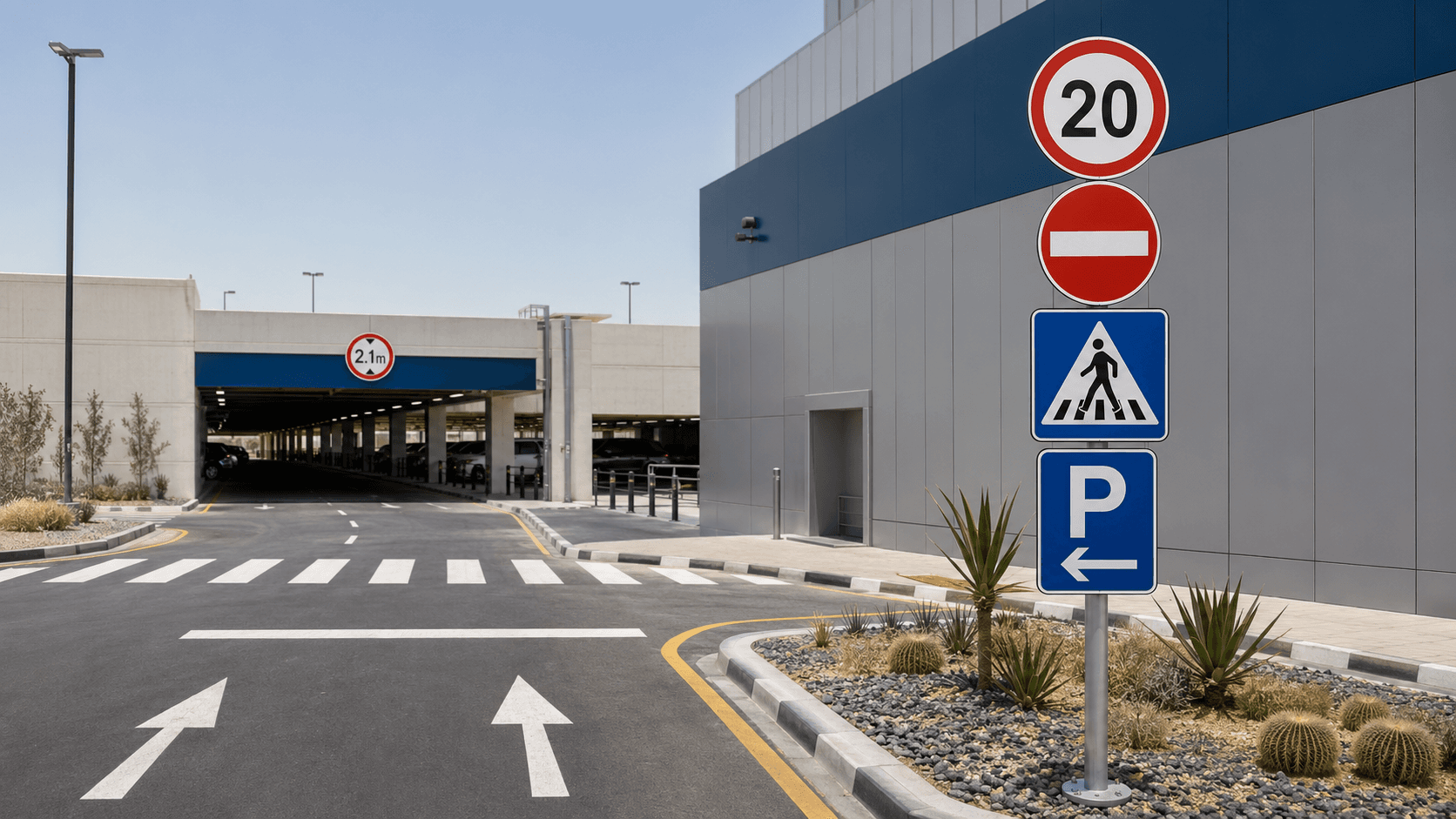
Traffic signs are not merely elements installed along a road or inside a parking facility. They are engineering communication tools that convey instructions drivers and pedestrians must detect, read, understand, and act upon within a limited amount of time.
A sign may carry the correct message yet still fail functionally because it is too small, has insufficient retroreflectivity, is poorly positioned, contains too much information, or conflicts with pavement markings and actual traffic movement.
The selection of traffic signs should therefore be based on a proper assessment of the site and its actual operation, while complying with the project plans, the client’s requirements, and relevant approved references, including the Saudi Road Code Library published by the Roads General Authority.
Short Answer: How Do You Choose the Right Traffic Signs?
To select the appropriate traffic signs for a road or parking project, seven main factors must be considered:
The type of site and how it is used.
The function of each sign and the message it must communicate.
Vehicle speed, sight distance, and available decision-making time.
Traffic volume, vehicle types, and the presence of pedestrians.
Approved sign size, colors, symbols, and design.
The appropriate reflectivity grade and materials for the environment.
Sign placement, mounting method, and maintenance plan.
Choosing the right signs does not mean purchasing the largest signs or the highest-grade materials available. It means designing a system that delivers the right message clearly, at the right place and time.
Why Does Traffic Sign Selection Affect Project Safety?
Reducing Sudden Decisions
When information reaches drivers early enough, they can change lanes, reduce speed, or stop gradually and safely. Late or unclear signs may force drivers to turn suddenly or stop within an active traffic lane.
Organizing Vehicle and Pedestrian Movement
Regulatory and directional signs help define priorities, directions, parking areas, and crossing points. This reduces conflicts between vehicles and pedestrians on roads, inside parking facilities, and throughout commercial or industrial premises.
Improving Operational Efficiency
In parking facilities, commercial complexes, and industrial sites, a well-designed sign system reduces unnecessary circulation, congestion at entrances, improper parking, and vehicles travelling against the intended direction of movement.
Enhancing Night-Time Visibility
Selecting suitable retroreflective materials and installing signs at the correct angle help keep their messages visible at night and under low-light, dusty, or rainy conditions.
First: Classify the Project and Sign Locations
No single specification is suitable for every location. A sign designed for a highway may not be suitable for an indoor parking facility, while signs used in a commercial complex differ from those required within an industrial site.
Highways and Arterial Roads
High-speed roads require signs that can be detected and read from a sufficient distance. Messages must be concise, sign dimensions must be appropriate, and signs must be arranged in a sequence that gives drivers enough time to make safe decisions.
These locations also require consideration of wind loads, support structures, foundations, lateral clearance, and the need to prevent the sign or its post from becoming an additional roadside hazard.
Urban and Local Roads
Urban roads contain more intersections, access points, pedestrian movements, and parked vehicles. Sign placement must therefore balance clear visibility with the need to avoid obstruction by buildings, trees, parked vehicles, or street furniture.
Parking Facilities
Vehicle speeds are relatively low inside parking facilities, but the number of decisions drivers must make is high. Drivers need to identify entrances, exits, travel directions, floors, zones, and parking locations while remaining aware of pedestrians, ramps, and areas with restricted visibility.
Industrial Facilities and Warehouses
Traffic sign selection must account for different vehicle sizes, truck and equipment movement, loading zones, height restrictions, permitted weights, pedestrian routes, and restricted operational areas.
Work Zones and Temporary Diversions
Temporary signs must form part of an integrated traffic control plan rather than being distributed randomly. They should indicate the beginning of the work zone, lane changes, temporary speed limits, diversions, and the end of restrictions in a clear and approved sequence.
Second: Determine the Function of Each Traffic Sign
Regulatory Signs
Regulatory signs communicate mandatory rules, restrictions, and instructions, including:
Stop and Give Way.
Speed limits.
No Entry.
Mandatory travel directions.
No Parking or No Stopping.
Height or weight restrictions.
Lanes designated for specific vehicle categories.
Approved shapes, symbols, and colors must be used because unplanned modifications may change how the message is understood or weaken its regulatory effect.
Warning Signs
Warning signs alert drivers to an upcoming hazard or change in road conditions, including:
Sharp curves.
Intersections.
Speed humps.
Road narrowing.
Pedestrian crossings.
Truck movement.
Slippery surfaces.
Work zones.
Their effectiveness depends on placing them far enough in advance of the hazard to allow drivers to notice the sign and respond safely.
Guide and Directional Signs
Guide signs help drivers reach the correct destination by identifying:
Road names and destinations.
Entrance and exit directions.
Lane or floor numbers.
Service and facility locations.
Emergency and evacuation routes.
Parking and loading zones.
The number of words and destinations displayed on a single sign should be limited so that the sign does not become a block of information that is difficult to read while driving.
Facility and Parking Signs
These include signs for accessible parking spaces, restrooms, elevators, electric vehicle charging areas, assembly points, and public facilities.
Such signs may be coordinated with the facility’s visual identity, provided that the commercial design does not alter the meaning of recognized traffic symbols or reduce their visibility.
Intelligent Traffic Signs
Some locations may require variable message signs, parking occupancy indicators, or electronic warning and guidance signs. These technologies should be used only where there is a clear operational need and a reliable system for updating and maintaining the displayed information.
Third: Conduct a Site Survey Before Selecting the Signs
Study Traffic Movement Paths
Vehicle routes should be reviewed from the point of entry through to the exit. Every location where a driver must make a decision should be identified: Where should the driver turn? Which lane should be selected? Is the driver required to stop or give way?
Identify Conflict and Hazard Points
Conflict points may include intersections, pedestrian crossings, ramps, blind corners, loading areas, facility entrances, and locations where passenger vehicles interact with trucks or operational equipment.
Measure the Available Sight Distance
Drivers must be able to see each sign without obstruction from trees, posts, vehicles, or other signs. Curves, gradients, and different angles of approach must also be considered.
Review Site Operation During the Day and at Night
A sign may appear clear during daylight but become difficult to see at night because of insufficient retroreflectivity or lighting. Glare may also prevent drivers from reading it.
The site should therefore be assessed under different lighting conditions rather than being evaluated only through plans and drawings.
Understand the Types of Site Users
Requirements differ between a road used daily by familiar drivers and a site primarily visited by first-time users. Tourist destinations, airports, hospitals, and major commercial complexes require particularly clear and logically sequenced wayfinding systems.
Fourth: Select the Appropriate Technical Specifications
Sign Size and Letter Height
Sign dimensions are determined according to approach speed, the number of words, the number of traffic lanes, lateral distance from the driver, viewing angle, and the time available to read the message and make a decision.
As speed or the distance between the sign and the driver’s path increases, larger symbols, letters, and sign dimensions may be required to support early reading. Smaller signs may be suitable inside parking facilities, provided they remain clearly visible from the vehicle’s path.
A single fixed sign size should not be adopted for every project location without proper assessment.
Message Content
An effective traffic sign message should be:
Short and direct.
Free from unnecessary wording.
Arranged according to decision priority.
Supported by a recognizable symbol whenever possible.
Consistent with the other signs used throughout the project.
If drivers are expected to read an entire paragraph, the underlying wayfinding system probably requires redesign.
Colors, Shapes, and Symbols
Traffic sign colors and shapes are associated with specific functions and should not be changed merely to match a facility’s interior design or brand identity.
Branding may be incorporated into site identification and wayfinding signs, but it must not replace the standardized design of regulatory or warning signs.
Retroreflective Sheeting
Retroreflective sheeting redirects light from vehicle headlights toward the driver, improving sign visibility at night. The appropriate reflectivity grade depends on:
Road classification and operating speed.
Sign type and importance.
Ambient lighting levels.
Angle of approach.
Project and client requirements.
Required service life.
Using the highest available reflectivity grade is not automatically the correct decision. The objective is to use the approved grade that provides appropriate visibility without excessive glare or inconsistencies between signs.
Sign Substrate and Protective Layers
Aluminum is commonly used to manufacture traffic signs because it is lightweight and resistant to corrosion. However, some applications may require different materials or thicknesses depending on sign dimensions, structural loads, and mounting methods.
The need for protection against ultraviolet radiation, scratching, vandalism, moisture, and coastal salinity should also be assessed.
Posts, Supports, and Foundations
The selection process does not end with the sign face. Posts, foundations, and fixing components are essential to both performance and safety.
They should be determined according to:
Sign area and weight.
Design wind speed.
Soil conditions.
Position relative to the road.
Mounting height and lateral clearance.
The likelihood of vehicle impact.
Corrosion protection requirements.
Fifth: Determine the Sign Location Using an Engineering Approach
Place the Sign Before the Decision Point
A sign must appear before an intersection, entrance, or hazard with enough time for drivers to detect, read, understand, and respond to it.
Installing a sign at the turning point itself makes the information late, even if the sign is otherwise perfectly visible.
Maintain a Clear Line of Sight
A sign must not obstruct other important elements, nor should it be hidden by trees, advertisements, posts, or vehicles. Future plant growth and seasonal changes should also be considered.
Set the Correct Height and Lateral Clearance
The mounting height and distance from the traffic lane depend on the road type, site conditions, and the presence of pedestrians or footpaths.
Inside covered parking facilities, ceiling height, pipes, fire protection systems, and visibility from behind large vehicles must also be considered.
Adjust the Sign Angle
An incorrect angle may reduce retroreflection, produce glare, or make a sign readable from one direction but not another. The sign face should therefore be aligned with the actual direction of approach.
Avoid Sign Clutter
Installing several signs close together, particularly where their messages compete or conflict, divides driver attention and weakens the most important instruction.
Information should instead be arranged in stages according to the sequence of decisions, while duplicate or outdated signs should be removed.
Sixth: What Is the Difference Between Road Signs and Parking Signs?
Road Signs
Road signs generally deal with higher speeds, longer reading distances, and stricter regulatory and structural requirements. Their design focuses on:
Early warning.
Clear lane and destination guidance.
Compatibility with road speed.
Night-time retroreflectivity.
Resistance to wind and environmental conditions.
Approval by the relevant authority.
Parking Facility Signs
Vehicle speeds are lower inside parking facilities, but decision points and interactions with pedestrians are more frequent. Typical requirements include:
Entrance and exit signs.
Travel directions and one-way routes.
Speed limits.
Stop and Give Way signs.
Pedestrian crossings and walkways.
Accessible parking signs.
Height and weight restrictions.
Loading and waiting areas.
No Parking signs at emergency exits.
Floor, zone, and row numbers.
Payment and exit guidance.
In multi-storey parking facilities, zone colors, numbering systems, overhead signs, and column identification must function as one coordinated wayfinding system rather than as separate elements.
Seventh: Make Traffic Signs Part of an Integrated Safety System
Integration with Pavement Markings
The arrows and directions displayed on signs must match the pavement arrows and lane markings.
Any conflict between the two will confuse drivers and increase the likelihood of vehicles travelling in the wrong direction.
Integration with Pedestrian Crossings
A pedestrian crossing sign alone may not be sufficient in every location. The area may also require clear pavement markings, suitable lighting, speed-calming measures, pavement protection, and improved visibility.
Integration with Night-Time Visibility Elements
Signs in critical areas may be supported by road studs, pavement reflectors, warning lights, or other reflective elements, depending on the site assessment and project requirements.
Integration with Speed Management
When speed reduction is required, the speed limit sign should be coordinated with road geometry, speed humps, other traffic-calming measures, and advance warnings.
A sign that does not correspond with the actual design of the road may fail to achieve the intended driver behavior.
Eighth: Consider Saudi Environmental Conditions
Heat and Ultraviolet Radiation
Long-term exposure to heat and ultraviolet radiation can cause colors to fade and may degrade printing layers and adhesives. Materials should therefore be selected according to the expected operational lifespan.
Dust and Sand
Dust accumulation reduces sign visibility and retroreflectivity, particularly on open roads and within industrial areas. Cleaning and regular inspection should therefore form part of the operating plan.
Humidity and Salinity
Coastal locations require additional attention to the selected metals, coatings, and fixing components to prevent premature corrosion.
Wind and Sandstorms
As sign area and mounting height increase, the structural loads acting on posts and foundations also increase. Sign-face design should therefore not be separated from the structural calculations of the mounting system.
Ninth: Inspect the Signs After Installation and During Operation
Pre-Installation Inspection
Before manufacturing and installation, the sign schedule, symbols, text, dimensions, locations, directions, and material types should all be reviewed.
Field Acceptance Inspection
Field acceptance should confirm that sign surfaces are undamaged, posts are properly aligned, bolts are secure, mounting heights and angles are correct, and no obstacles interfere with the line of sight.
Night-Time Inspection
Daytime inspection alone is not sufficient. The route should be driven at night from the actual directions of approach to verify sign visibility and confirm that there is no excessive glare or insufficient retroreflection.
Create an Asset Register
Recording the location, type, installation date, photograph, and condition of each sign helps organize maintenance and replacement while preventing signs from being lost, overlooked, or unnecessarily duplicated.
Maintenance and Replacement
A sign may require cleaning, repair, or replacement when its colors fade, retroreflectivity decreases, the panel becomes bent, it is damaged by an impact, or the project’s routes and operating conditions change.
Common Mistakes When Selecting Traffic Signs
Choosing Signs Based Only on Price
Lower-cost materials may lead to rapid fading, poor night-time visibility, or higher long-term replacement and maintenance costs.
Using One Sign Size in Every Location
Differences in speed, visibility, and the distance between the sign and the traffic lane make it inappropriate to adopt one size without assessing each location.
Displaying Too Much Information
Excessive text reduces readability, particularly when drivers are moving or approaching an intersection where they must make a quick decision.
Using Non-Standard Symbols or Colors
Custom symbols may look visually attractive, but they force drivers to interpret a new message instead of recognizing a familiar one immediately.
Installing Signs After Decision Points
A late sign does not provide drivers with enough time to respond and may lead to sudden changes in speed or direction.
Ignoring Night-Time Visibility
A sign that appears clear in daytime site photographs may not perform effectively at night or during dusty or rainy conditions.
Failing to Coordinate Signs with Pavement Markings
A sign arrow that conflicts with the direction of a pavement arrow is one of the most serious errors affecting traffic flow through parking areas and facility entrances.
Installing Too Many Signs
More signs do not necessarily create greater safety. Repeated or conflicting messages may hide or weaken the most important instruction.
Checklist Before Approving Project Traffic Signs
Before manufacturing and installation, confirm the following:
Has the road or parking facility type and its operating conditions been identified?
Have vehicle and pedestrian movements been reviewed?
Does every sign have a clear and necessary function?
Do the symbols, colors, and shapes comply with approved requirements?
Is the sign size appropriate for the speed and reading distance?
Is the message short and clear?
Is the reflectivity grade appropriate for the location?
Can the materials withstand the environmental conditions?
Are the posts and foundations suitable for the expected loads?
Is the sign positioned before the decision point?
Is the line of sight free from obstructions?
Are the signs coordinated with the pavement markings?
Has the design been reviewed by the relevant authority?
Is there a plan for inspection, maintenance, and replacement?
Frequently Asked Questions About Selecting Traffic Signs
What Is the Most Important Factor When Choosing a Traffic Sign?
The most important factor is whether road users can detect, read, understand, and respond to the message before reaching the relevant decision point or hazard.
This is affected by speed, sign dimensions, placement, retroreflectivity, and message clarity.
How Is Traffic Sign Size Determined?
Sign size is determined according to approach speed, sight distance, the number of words and symbols, the number of traffic lanes, sign location, client requirements, and approved project plans.
There is therefore no single sign size suitable for every project.
Is the Highest Reflectivity Grade Always the Best?
Not necessarily. The selected grade should comply with the specifications and be suitable for the road type, sign function, lighting conditions, and viewing angle.
It should provide consistent visibility without causing excessive glare.
Do Private Parking Facilities Need Standardized Traffic Signs?
Yes. Instructions relating to speed, parking, priority, travel directions, and pedestrian crossings must be clear and consistent with recognized traffic symbols, even when the parking facility is located on private property.
Can Corporate Brand Colors Be Used on Parking Signs?
Corporate colors may be used on signs identifying zones, floors, services, and facilities, provided they do not replace the standardized colors and shapes of regulatory or warning signs or reduce their visibility.
When Should Traffic Signs Be Replaced?
Signs should be replaced when they lose visibility or retroreflectivity, become damaged or bent, no longer correspond with the current route, or reach the end of their specified service life under the asset management plan.
Conclusion
Selecting the right traffic signs for road and parking projects is an engineering decision that begins with studying movement patterns and risks and does not end with manufacturing and installing the sign.
The objective is to create an integrated system that delivers the correct information to drivers and pedestrians at the right time and performs effectively during the day, at night, and under different operating conditions.
Safety Triangle Contracting Co. provides integrated traffic safety solutions that include assessing site requirements, supplying and installing traffic signs, and coordinating them with pavement markings, night-time visibility elements, and traffic management systems to create clearer, safer, and more efficient roads and parking facilities.
