

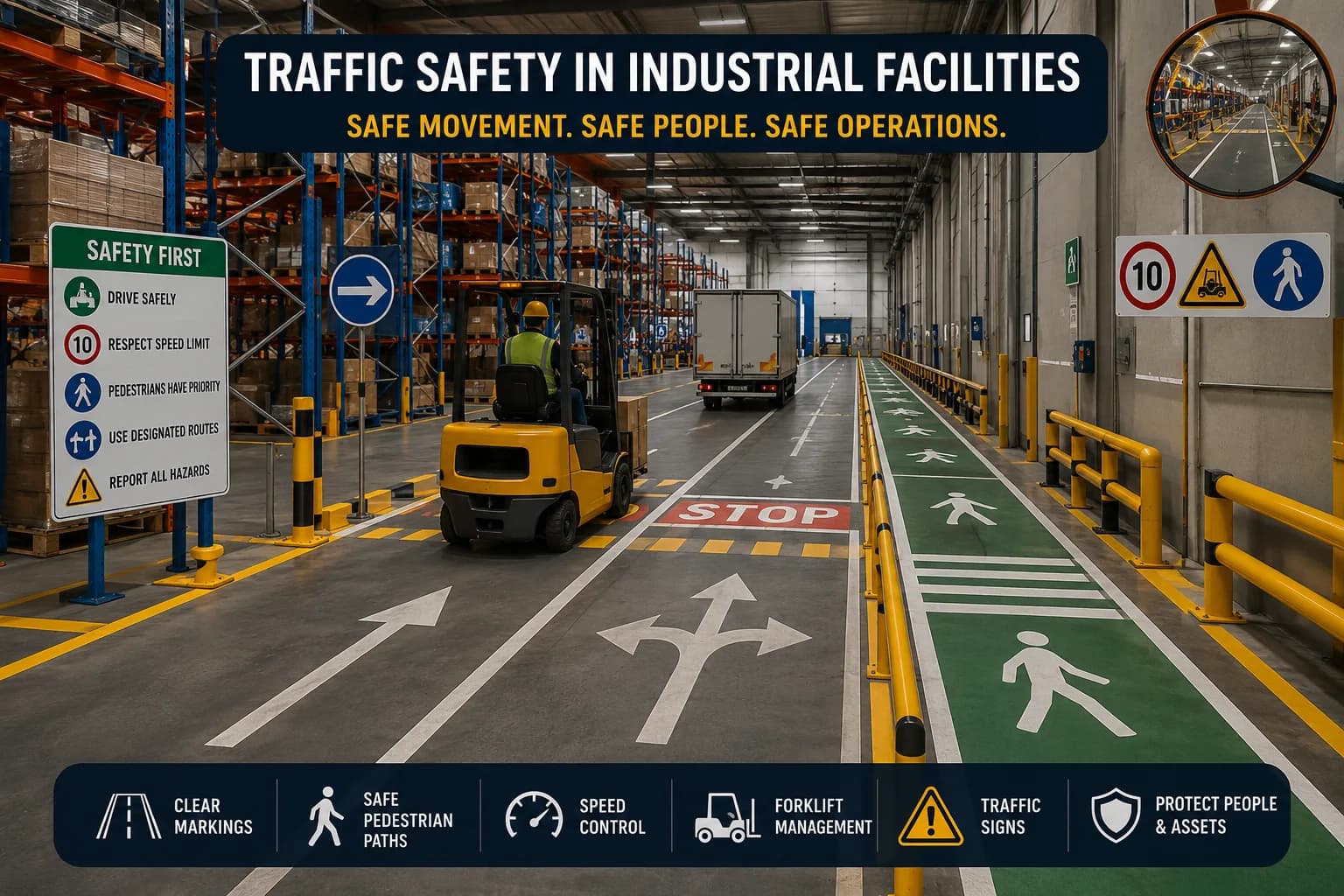
Industrial facilities and warehouses experience constant movement of trucks, forklifts, heavy equipment, employees, and visitors. Without a well-planned internal traffic management system, these environments become highly susceptible to accidents, operational delays, and costly property damage.
Many workplace incidents are not caused solely by operator error but by poor traffic engineering, inadequate pavement markings, insufficient signage, or the absence of clear separation between vehicles and pedestrians.
Today, internal traffic safety is considered a fundamental component of occupational health and safety (OHS) programs, helping organizations improve productivity, reduce operational risks, and maintain regulatory compliance.
This guide explores the key engineering principles for designing an effective traffic safety system for industrial facilities and warehouses.
Why Is Traffic Safety Important in Industrial Facilities?
Traffic safety is just as important inside industrial sites as it is on public roads.
A professionally designed traffic management system helps:
Reduce workplace accidents.
Protect employees and visitors.
Organize heavy equipment movement.
Improve logistics efficiency.
Minimize damage to infrastructure and equipment.
Enhance workflow productivity.
Support compliance with workplace safety regulations.
As vehicle movement increases, so does the need for a structured traffic control system.
Common Traffic Hazards in Warehouses and Industrial Sites
Industrial environments present unique traffic challenges due to the interaction between machinery, vehicles, and personnel.
Forklift–Pedestrian Collisions
One of the most common workplace accidents occurs when forklifts and pedestrians share the same pathways.
Truck and Vehicle Conflicts
Loading areas often experience congestion where trucks interact with smaller service vehicles.
Limited Visibility
Blind corners, narrow aisles, and storage racks significantly reduce driver visibility.
Excessive Speed
Even moderate speeds inside industrial facilities can result in severe injuries and equipment damage.
Inadequate Traffic Signage
Missing or unclear traffic signs increase confusion for both employees and visitors.
Professional Pavement Marking Design
Pavement markings form the foundation of an organized internal traffic system.
They should include:
Vehicle Lanes
Clearly marked travel lanes improve traffic flow and reduce conflicts.
Directional Arrows
Guide drivers safely throughout the facility.
Stop Lines
Installed at intersections and hazardous crossing points.
Loading and Unloading Zones
Prevent unauthorized parking and operational disruptions.
Numbered Aisles and Routes
Improve navigation and emergency response.
Industrial-grade pavement marking materials should be used to withstand heavy traffic, chemicals, and harsh environmental conditions.
Separating Pedestrians from Vehicles
One of the most effective traffic safety strategies is creating physical and visual separation between pedestrians and moving equipment.
Dedicated Walkways
Clearly marked pedestrian routes improve visibility and safety.
Protective Barriers
Separate employees from heavy vehicle traffic.
Designated Crosswalks
Reduce conflicts by controlling crossing locations.
Controlled Access Routes
Prevent random pedestrian movement through operational zones.
This significantly lowers the risk of workplace injuries.
Forklift Traffic Management
Forklifts are essential to warehouse operations but also represent one of the highest accident risks.
Dedicated Forklift Routes
Whenever possible, forklifts should operate on exclusive pathways.
Speed Limits
Different operational areas require appropriate speed restrictions.
Warning Signs
Install caution signs before intersections and blind spots.
Convex Safety Mirrors
Improve visibility around corners.
Minimize Crossing Points
Reduce interactions between forklifts and pedestrians.
Truck Traffic Management
Modern warehouses often handle continuous truck traffic throughout the day.
Best practices include:
Separate Entry and Exit Gates
Reduce traffic conflicts.
One-Way Traffic Systems
Improve circulation and eliminate unnecessary crossings.
Designated Waiting Areas
Prevent congestion near loading docks.
Turning and Maneuvering Zones
Allow trucks to move safely without blocking traffic.
Traffic Signs Within Industrial Facilities
Traffic signs provide clear guidance for drivers, operators, and visitors.
Important signs include:
Speed Limit Signs
Control vehicle speeds throughout the site.
Directional Signs
Guide traffic efficiently.
Warning Signs
Alert drivers to potential hazards.
Priority Signs
Manage right-of-way at intersections.
Restricted Access Signs
Prevent unauthorized entry into hazardous areas.
Traffic Calming Measures
Speed control is essential for preventing workplace accidents.
Common solutions include:
Speed Humps
Installed near pedestrian crossings and high-risk areas.
Rumble Strips
Alert drivers to reduce speed.
Visual Speed Reduction Markings
Encourage slower driving through pavement design.
Improving Night-Time Visibility
Facilities operating around the clock require enhanced visibility solutions.
These include:
Reflective Road Studs
Improve lane visibility in low-light conditions.
Reflective Pavement Markings
Increase nighttime guidance.
Adequate Lighting
Illuminate traffic routes, loading areas, and intersections.
Reflective Hazard Markers
Highlight fixed obstacles and infrastructure.
Protecting Buildings and Infrastructure
Vehicle impact protection minimizes costly structural damage.
Recommended solutions include:
Wheel Stops
Protect sidewalks and parking areas.
Steel Safety Barriers
Shield sensitive equipment and work zones.
Column Protectors
Prevent structural damage from forklifts.
Dock Protection Systems
Protect loading bays from truck impacts.
Routine Maintenance of Traffic Safety Systems
Even the best-designed traffic system requires continuous maintenance.
Maintenance activities include:
Repainting Pavement Markings
Restore visibility as markings wear over time.
Replacing Damaged Signs
Maintain clear communication throughout the facility.
Cleaning Reflective Devices
Ensure maximum nighttime performance.
Inspecting Traffic Calming Devices
Repair or replace damaged speed humps and barriers.
How Traffic Safety Improves Operational Efficiency
Traffic safety is not only about preventing accidents—it also improves overall business performance.
Benefits include:
Faster internal transportation.
Higher operational productivity.
Reduced downtime caused by accidents.
Lower maintenance and repair costs.
Better protection of assets.
Improved workplace safety culture.
Greater regulatory compliance.
Why Choose Safety Triangle?
Safety Triangle Contracting provides comprehensive traffic safety solutions for industrial facilities and warehouses, from engineering studies and traffic planning to professional installation of traffic safety products and infrastructure.
Our services include:
Professional pavement markings.
Industrial traffic signs.
Reflective road studs.
Speed humps.
Wheel stops.
Internal traffic management systems.
Complete industrial traffic safety solutions.
Frequently Asked Questions
Why is traffic safety important inside industrial facilities?
It protects employees, organizes vehicle movement, reduces accidents, and improves operational efficiency.
How is industrial traffic safety different from public road safety?
Industrial traffic safety focuses on managing forklifts, trucks, heavy equipment, and pedestrians within controlled operational environments.
What are the most common warehouse traffic hazards?
Forklift collisions, blind spots, speeding, poor pavement markings, and inadequate traffic signage.
What are the essential components of an industrial traffic safety system?
Pavement markings, traffic signs, pedestrian crossings, speed control devices, reflective safety products, protective barriers, and routine maintenance.
How often should traffic safety systems be maintained?
Facilities should conduct regular inspections and promptly repaint markings, replace damaged signs, and maintain reflective devices to ensure maximum effectiveness.
