

Parking Lot Traffic Safety Guide: Best Practices for Commercial and Industrial Facilities
Modern parking facilities are no longer simple spaces designated for vehicle storage. In commercial and industrial environments, parking areas function as active operational zones where vehicles, pedestrians, delivery trucks, forklifts, and service equipment interact continuously. As traffic volumes increase across Saudi Arabia's expanding infrastructure and business sectors, parking lot traffic safety has become a critical operational requirement rather than an optional enhancement.
Poor traffic planning within parking areas can lead to vehicle collisions, pedestrian incidents, operational disruptions, increased insurance claims, property damage, and negative customer experiences. A well-designed traffic safety system, on the other hand, enhances operational efficiency, protects assets, and reinforces an organization's commitment to safety.
This comprehensive guide explores the essential components of traffic safety in commercial and industrial parking facilities, helping facility owners, project managers, and safety professionals implement effective solutions that minimize risks and maximize efficiency.
Why Parking Lot Traffic Safety Matters
Although parking lot incidents often occur at relatively low speeds, they represent a significant portion of vehicle-related accidents in commercial environments.
Common causes include:
Poorly visible pavement markings.
Lack of directional signage.
Inefficient entry and exit design.
Inadequate pedestrian crossing arrangements.
Insufficient visual warning systems.
Uncontrolled parking behavior.
Limited nighttime visibility.
Even minor incidents can result in costly repairs, legal liabilities, operational interruptions, and diminished customer confidence.
Essential Components of Parking Lot Traffic Safety
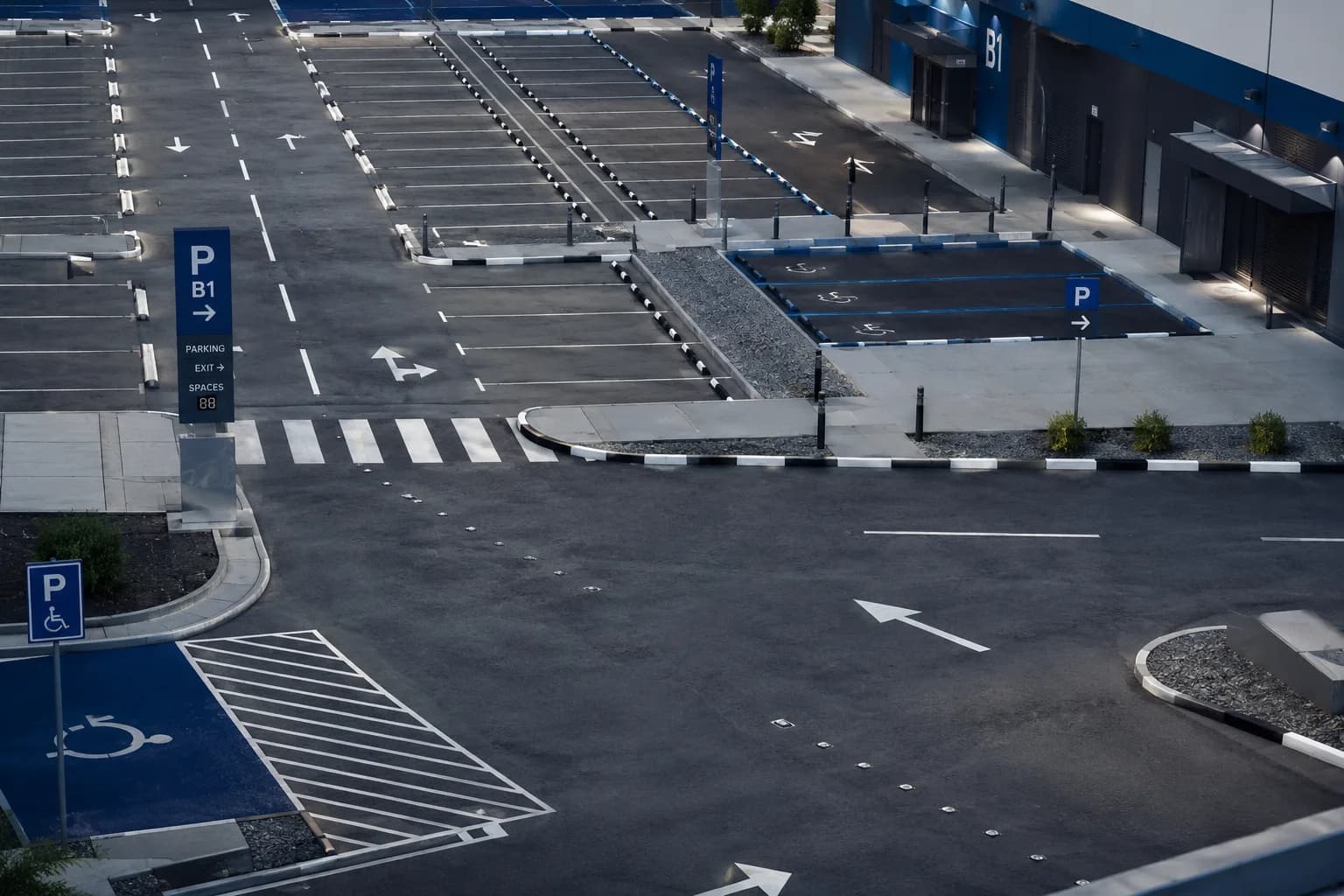
1. Clear Pavement Markings
High-quality pavement markings are the foundation of an effective parking safety system.
They should clearly identify:
Parking spaces.
Traffic flow directions.
Stop lines.
Pedestrian crossings.
Loading and unloading zones.
Accessible parking spaces.
No-parking areas.
Emergency access routes.
Durable markings improve driver compliance and reduce confusion.
2. Traffic Signs and Directional Guidance
Traffic signs provide drivers with immediate instructions and help maintain orderly movement throughout the facility.
Common parking signs include:
Entrance.
Exit.
Do Not Enter.
One Way.
Speed Limit.
Pedestrian Crossing.
Accessible Parking.
Height Restrictions.
Emergency Assembly Points.
Reflective materials should be used to maintain visibility during both daytime and nighttime operations.
3. Wheel Stops and Parking Blocks
Parking stops help:
Prevent vehicle overrun.
Protect sidewalks and structures.
Reduce low-speed impacts.
Improve parking alignment.
Organize vehicle positioning.
Heavy-duty materials are recommended for long-term durability.
4. Road Studs and Ground Reflectors
Road studs and reflective markers significantly improve visibility in areas where lighting conditions may be limited.
They are particularly effective in:
Entry and exit points.
Curved sections.
Underground parking facilities.
Multi-story parking structures.
Industrial sites operating around the clock.
These systems provide continuous visual guidance for both drivers and pedestrians.
5. Safe Pedestrian Crossings
Pedestrian safety should be integrated into every parking lot design.
Crosswalks should be:
Clearly visible.
Strategically located.
Marked with high-visibility coatings.
Supported by warning signs.
Positioned along natural walking paths.
Facilities with heavy foot traffic may require enhanced pedestrian warning systems.
Traffic Safety Challenges in Industrial Parking Areas
Industrial environments introduce additional risks due to the presence of:
Heavy trucks.
Forklifts.
Loading equipment.
Delivery vehicles.
Continuous operational movement.
Loading and unloading activities.
As a result, industrial facilities require more advanced safety strategies.
Separate Traffic Flows
Pedestrian routes should be physically or visually separated from:
Passenger vehicle routes.
Truck movement corridors.
Equipment operating zones.
This separation minimizes conflict points and reduces collision risks.
Speed Management
Lower speed limits should be enforced within industrial facilities.
Traffic calming measures may include:
Speed limit signs.
Pavement warnings.
Raised crossings.
Physical speed control devices.
Enhanced Visual Warnings
Industrial environments often involve elevated noise levels that limit the effectiveness of audible alerts.
Visual safety systems such as reflectors, warning signs, and illuminated guidance devices become increasingly important.
Common Mistakes That Compromise Parking Safety
Organizations frequently overlook critical elements that affect parking lot performance.
Common mistakes include:
Using low-quality pavement materials.
Neglecting routine maintenance.
Failing to install adequate signage.
Ignoring pedestrian movement patterns.
Providing insufficient nighttime guidance.
Overlooking accessibility requirements.
Failing to accommodate future expansion.
Addressing these issues early significantly reduces long-term costs.
How to Select the Right Safety Solutions
The appropriate traffic safety strategy depends on several factors.
Facility Type
Examples include:
Shopping malls.
Hospitals.
Universities.
Residential compounds.
Manufacturing facilities.
Warehouses.
Logistics centers.
Traffic Volume
Higher vehicle volumes require more sophisticated traffic control measures and visual guidance systems.
Vehicle Characteristics
The safety design should account for:
Passenger vehicles.
Heavy trucks.
Service fleets.
Material handling equipment.
Operating Hours
Facilities operating during nighttime periods require enhanced visibility solutions to maintain safe conditions.
The Financial Benefits of Investing in Traffic Safety
Traffic safety improvements should not be viewed solely as expenses.
They generate measurable returns by:
Reducing accidents.
Lowering repair costs.
Minimizing insurance claims.
Improving customer satisfaction.
Increasing operational efficiency.
Protecting infrastructure assets.
Supporting regulatory compliance.
The long-term savings often outweigh the initial investment.
The Future of Smart Parking Safety in Saudi Arabia
As Saudi Arabia advances toward Vision 2030 and smart city initiatives, parking facilities are increasingly integrating intelligent technologies such as:
Smart parking guidance systems.
Advanced nighttime visibility solutions.
Occupancy detection technologies.
Solar-powered warning systems.
Digital parking management platforms.
Data-driven operational monitoring.
Traffic safety is evolving from a passive requirement into a strategic operational function that supports sustainability, efficiency, and user experience.
Frequently Asked Questions
What is the most important aspect of parking lot traffic safety?
Clear pavement markings and organized traffic flow form the foundation of an effective safety strategy.
Do small parking facilities require traffic signs?
Yes. Even small facilities benefit from directional guidance and regulatory signage.
Are road reflectors necessary?
They are highly recommended in areas with reduced lighting or nighttime operations.
How often should parking markings be renewed?
Inspection schedules should be based on traffic volume, environmental conditions, and material performance.
Are industrial parking requirements different from commercial facilities?
Yes. Industrial sites involve additional risks associated with heavy equipment and operational traffic.
Why should pedestrian routes be separated?
Separation reduces interaction between people and moving vehicles, lowering the likelihood of incidents.
Is investing in parking safety cost-effective?
Absolutely. Effective safety measures reduce liabilities and contribute to smoother daily operations.
Conclusion
Traffic safety in parking facilities extends far beyond painting lines on asphalt. It requires a comprehensive engineering approach that addresses vehicle movement, pedestrian behavior, operational requirements, and future growth.
By implementing appropriate traffic safety solutions, commercial and industrial facilities can reduce risks, improve user experiences, protect assets, and enhance operational performance.
As organizations continue to prioritize efficiency and sustainability, parking lot traffic safety will remain a defining characteristic of well-managed infrastructure.
