

This comprehensive guide explores:
Technical specifications
Engineering applications
Installation considerations
Common failure causes
Product selection standards
Smart infrastructure integration
What Are Solar Road Studs?
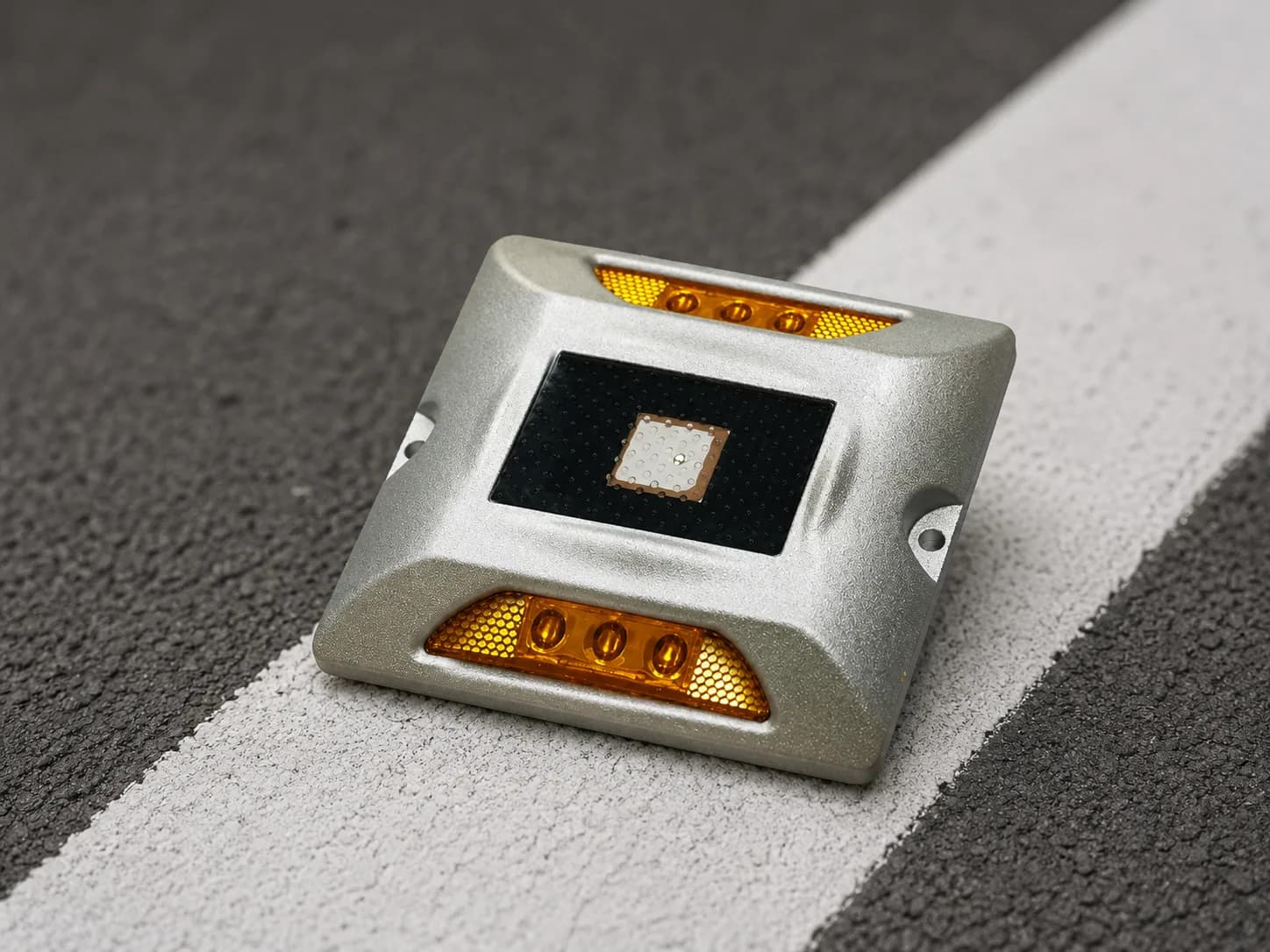
Solar road studs are self-powered illuminated road safety devices installed on highways, intersections, tunnels, parking areas, and pedestrian crossings.
Each unit typically contains:
Solar photovoltaic cells
Rechargeable battery or supercapacitor
High-intensity LEDs
Heavy-duty housing
Automatic light sensors
Key Advantages of Solar Road Studs
Enhanced Night Visibility
Active LED illumination provides visibility distances exceeding:
d≥800 md \ge 800\ \mathrm{m}d≥800 m
This significantly improves driver reaction time.
Improved Safety Performance
Solar studs help:
Prevent lane departure
Improve curve visibility
Enhance driver guidance
Reduce nighttime collisions
Smart Infrastructure Compatibility
They are widely adopted in:
Smart city projects
Highways
Tourism developments
Sustainable infrastructure initiatives
Technical Specifications
Feature | Professional Standard |
|---|---|
Housing Material | Cast Aluminum |
Load Capacity | 20–30 Tons |
Protection Rating | IP68 |
Battery Type | Heat-resistant Lithium or Supercapacitor |
Visibility Range | Up to 800 meters |
Working Duration | 72+ hours |
Common Applications
Highways
Dangerous curves
Tunnel entrances
Bridges
Parking facilities
School zones
Tourist destinations
Common Installation Mistakes
Low-Quality Products
Cheap products often fail due to:
Weak batteries
Water leakage
Low structural durability
Incorrect Installation
Common errors include:
Poor surface preparation
Weak adhesive materials
Incorrect alignment angles
Integrated Traffic Safety Solutions
Explore related traffic safety systems:
FAQ
Do solar road studs work in desert climates?
Yes. Professional-grade units are specifically designed for high-temperature and dusty environments.
Do they require electricity?
No, they operate entirely on solar energy.
Are they suitable for highways?
Absolutely. They are widely used in modern highway infrastructure.
