

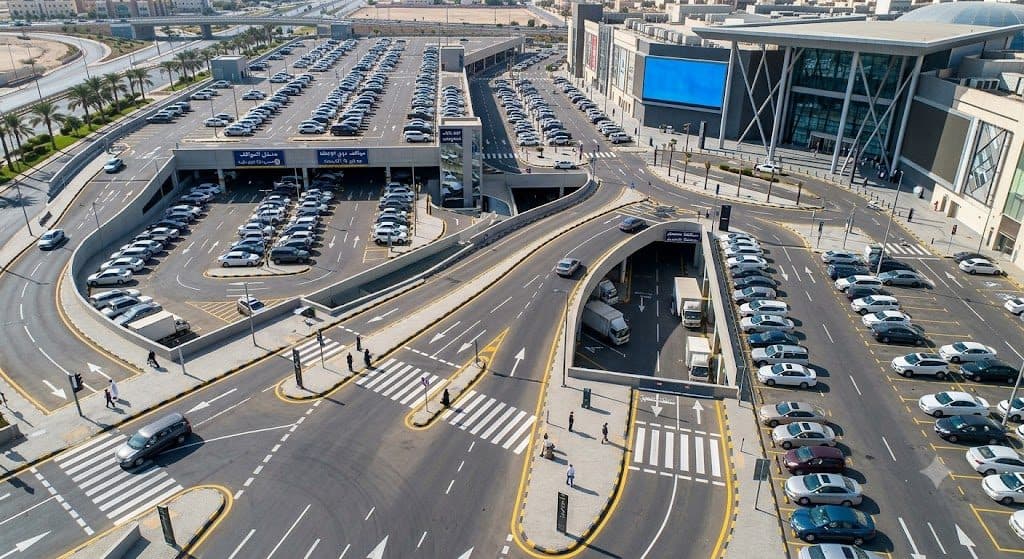
Excerpt
Discover the most effective traffic safety solutions for shopping malls and large commercial centers, including pavement markings, traffic signs, pedestrian protection systems, parking management, and smart traffic technologies that improve safety, operational efficiency, and the overall visitor experience.
Introduction
Shopping malls and large commercial centers welcome thousands of visitors every day, making them among the busiest environments for both vehicles and pedestrians. As commercial developments continue to expand across Saudi Arabia, traffic safety within these facilities has become a critical factor in project success rather than merely a regulatory requirement.
An effective traffic management design goes far beyond organizing vehicle movement. It is intended to:
Protect visitors and pedestrians from potential hazards.
Improve the arrival and entry experience.
Reduce collisions and parking lot accidents.
Enhance operational efficiency while preserving infrastructure over the long term.
This guide explores the most important traffic safety solutions that should be implemented in shopping malls and large commercial facilities in accordance with modern traffic engineering best practices.
Why Is Traffic Safety a Priority in Shopping Malls?
Commercial centers possess several characteristics that make them more vulnerable to traffic incidents than public roadways, including:
High vehicle volumes during peak hours.
Continuous interaction between vehicles and pedestrians.
Drivers with varying levels of experience and driving behavior.
Frequent parking, reversing, and maneuvering movements.
Continuous traffic throughout the day, with significant increases during weekends, holidays, and seasonal events.
Consequences of Poor Traffic Organization
Without a well-designed traffic management system, commercial facilities may experience:
Severe traffic congestion.
Low-speed vehicle collisions.
Pedestrian accidents.
Disrupted traffic circulation.
Property damage and increased maintenance costs.
Negative impacts on customer satisfaction and the facility's reputation.
Core Elements of an Effective Traffic Safety System
Professional Pavement Markings
Pavement markings serve as the primary visual communication system between the facility and its drivers. A professionally designed parking facility should include:
Clearly defined parking bays.
Directional arrows.
Stop lines and speed reduction markings.
Highly visible pedestrian crossings.
Loading and unloading zones.
Clearly designated accessible parking spaces.
Emergency access routes and fire service lanes.
Engineering Recommendation
High-performance road marking materials should be used to ensure long-lasting visibility, superior durability, and resistance to heavy traffic loads.
Organized Entry and Exit Management
Well-planned access points significantly reduce congestion and improve traffic flow by:
Separating entry and exit points.
Providing multiple access gates when traffic demand requires.
Maintaining adequate sight distance at exits.
Installing advance directional signs before decision points.
Traffic Signs and Directional Guidance
Traffic signs are essential for guiding drivers and preventing unsafe movements within commercial facilities. Recommended signage includes:
Entrance, Exit, and One-Way signs.
Posted speed limit signs (typically 15–20 km/h).
Pedestrian Crossing and No Parking signs.
Vehicle height clearance signs for covered parking structures.
Reserved parking signs, including VIP and Accessible Parking.
Engineering Note
All traffic signs should utilize high-quality reflective materials to ensure excellent visibility during both daytime and nighttime conditions.
Pedestrian Protection
Pedestrians represent the most vulnerable road users within commercial centers. A safe pedestrian environment should include:
Clearly marked or raised pedestrian crossings at major entrances.
Protected walkways connecting parking areas to building entrances.
Safe and shaded waiting areas.
Dedicated lighting focused on pedestrian routes.
Core Elements of an Effective Traffic Safety System (Continued)
Reflective Road Studs and Pavement Delineators
Reflective road studs play a vital role in improving driver guidance and nighttime visibility within commercial developments. Their primary functions include:
Providing clear visual guidance through curves and intersections.
Enhancing nighttime visibility in poorly lit areas.
Defining roadway edges and highlighting hazardous locations.
Separating traffic lanes and organizing circulation within multi-level parking facilities.
Properly installed reflective road studs improve driver confidence, reduce navigation errors, and contribute to a safer traffic environment.
Wheel Stops
Wheel stops, whether manufactured from heavy-duty rubber or reinforced concrete, provide several important safety benefits:
Protect sidewalks and storefronts from vehicle impact.
Prevent vehicles from exceeding designated parking limits.
Encourage consistent and properly aligned parking.
They also help reduce property damage while maintaining an organized parking layout.
Speed Management
Vehicle speed is one of the most significant factors influencing accident severity within commercial facilities. Effective speed control measures include:
Clearly posted low-speed limits throughout the property.
Smooth rubber or concrete speed humps positioned near pedestrian crossings and intersections.
Optical traffic calming pavement markings designed to encourage drivers to reduce speed naturally.
Maintaining lower vehicle speeds significantly improves pedestrian safety and reduces the likelihood of serious collisions.
Traffic Safety Solutions for Multi-Level Parking Structures
Multi-storey parking facilities require additional engineering considerations due to enclosed environments, ramps, and limited visibility. Recommended safety solutions include:
Convex Safety Mirrors
Convex mirrors improve visibility around blind corners and sharp turns, allowing drivers to detect approaching vehicles before entering conflict areas.
Reflective Column Protection
Reflective protective panels installed on structural columns improve visibility and reduce the risk of vehicle impacts, particularly in confined parking spaces.
Continuous Lighting Systems
Uniform lighting throughout parking structures eliminates dark zones, improves visibility, enhances personal security, and supports CCTV performance.
Clear Traffic Direction Control
One-way circulation systems and highly visible directional signs help prevent wrong-way driving on ramps and improve overall traffic flow.
Traffic Safety Solutions for Loading and Delivery Areas
Large commercial centers accommodate continuous deliveries from suppliers and logistics providers. These operational zones should be engineered to maximize both safety and efficiency by:
Completely separating truck traffic from customer vehicle circulation.
Clearly identifying loading zones with pavement markings and traffic signs.
Restricting access to authorized vehicles only.
Installing heavy-duty rubber dock bumpers to protect loading platforms during docking operations.
A properly designed loading area minimizes conflicts between commercial vehicles and visitors while improving daily operational efficiency.
Common Traffic Safety Design Mistakes in Commercial Centers
Even modern commercial developments can experience traffic-related problems if proper traffic engineering principles are overlooked. The most common design mistakes include:
Poor pavement marking quality or the use of low-durability traffic paints.
Small, unclear, or improperly positioned traffic signs.
Insufficient pedestrian crossings, forcing visitors to walk between moving vehicles.
Poorly designed entry and exit points that create traffic queues extending onto surrounding public roads.
Inadequate nighttime visibility caused by insufficient lighting or neglected maintenance of traffic safety devices.
Failure to provide accessible ramps and safe pedestrian routes for people with disabilities.
Avoiding these issues during the planning and construction stages significantly enhances both safety and operational performance.
How Traffic Safety Improves the Customer Experience
An organized and well-designed traffic system directly enhances the visitor experience from the moment customers arrive. Key benefits include:
Easy and stress-free access to the facility.
Faster identification of available parking spaces.
Reduced congestion and shorter waiting times.
A safer and more comfortable environment for pedestrians and families.
These improvements encourage visitors to spend more time within the shopping center, increase repeat visits, and ultimately contribute to higher commercial value and customer satisfaction.
Investing in Traffic Safety Delivers Long-Term Value
Traffic safety should not be viewed as an additional expense but as a strategic long-term investment that provides measurable operational and financial benefits.
Implementing comprehensive traffic safety solutions helps organizations:
Reduce traffic accidents and associated legal liabilities.
Protect buildings, parking facilities, and surrounding infrastructure.
Lower long-term maintenance and repair costs.
Improve the efficiency of parking operations and vehicle circulation.
Enhance the overall reputation and value of the commercial property.
Well-planned traffic infrastructure continues delivering value throughout the lifecycle of the development.
The Future of Traffic Safety in Commercial Centers
Modern commercial developments across Saudi Arabia are increasingly integrating smart mobility technologies to improve safety, efficiency, and user experience. These technologies include:
Smart Parking Guidance Systems
Digital parking guidance systems display real-time parking availability using electronic message boards and overhead indicators, helping drivers locate vacant spaces quickly while reducing unnecessary circulation.
Solar-Powered Road Studs
Solar-powered road studs provide self-illuminating lane guidance during nighttime conditions without requiring external electrical infrastructure, improving visibility and roadway delineation throughout parking facilities.
AI-Based Traffic Monitoring
Artificial intelligence systems analyze traffic flow, identify congestion hotspots, and provide facility management teams with actionable insights for improving circulation and responding quickly to operational issues.
As commercial developments continue to evolve, intelligent traffic management technologies will play an increasingly important role in creating safer, smarter, and more sustainable transportation environments.
Frequently Asked Questions (FAQ)
What Is the Most Important Element of Traffic Safety in Shopping Malls?
The most important factor is a comprehensive traffic management design that integrates pavement markings, traffic signs, pedestrian protection systems, parking organization, and safe vehicle circulation into one coordinated strategy.
Do Small Commercial Centers Need Advanced Traffic Safety Solutions?
Yes. Even small retail developments benefit significantly from professional pavement markings, wheel stops, organized entry and exit points, traffic signs, and clearly defined pedestrian routes. Proper planning improves safety, reduces confusion, and creates a better visitor experience regardless of the project's size.
Why Are Pedestrian Crossings So Important?
Pedestrian crossings reduce conflict points between vehicles and pedestrians by directing foot traffic to designated crossing areas. This significantly lowers the risk of accidents while improving overall safety throughout the facility.
Does Pavement Marking Quality Affect Customer Experience?
Absolutely. Clear, durable pavement markings help drivers navigate the parking area with confidence, minimize confusion, reduce sudden vehicle movements, and improve overall traffic flow. A well-organized parking facility creates a safer and more convenient experience for visitors.
Conclusion
The success of a shopping mall or large commercial center depends on far more than its retail offerings. It begins the moment visitors enter the property.
Every element of a professionally designed traffic safety system—from pavement markings and traffic signs to pedestrian facilities, parking management, and speed control—contributes to creating a safer, more efficient, and more welcoming environment.
Investing in high-quality traffic safety infrastructure protects lives, safeguards valuable assets, enhances operational efficiency, and supports the long-term sustainability of commercial developments. As Saudi Arabia continues to develop world-class commercial destinations under Vision 2030, implementing modern traffic engineering solutions is no longer optional—it is an essential component of successful infrastructure planning.
Meta Title
Best Traffic Safety Solutions for Shopping Malls & Commercial Centers | Safety Triangle
Meta Description
Discover the best traffic safety solutions for shopping malls and commercial centers, including pavement markings, traffic signs, pedestrian protection systems, parking safety, and smart traffic technologies designed to improve safety, efficiency, and visitor experience.
URL Slug
traffic-safety-solutions-shopping-malls
Focus Keyword
Traffic Safety Solutions for Shopping Malls
SEO Keywords
Traffic Safety Solutions
Shopping Mall Traffic Safety
Commercial Center Traffic Management
Parking Lot Safety
Pavement Markings
Traffic Signs
Pedestrian Safety
Wheel Stops
Reflective Road Studs
Smart Parking Systems
Commercial Parking Design
Traffic Engineering
Road Safety Solutions
Parking Management
Saudi Arabia Traffic Safety
