

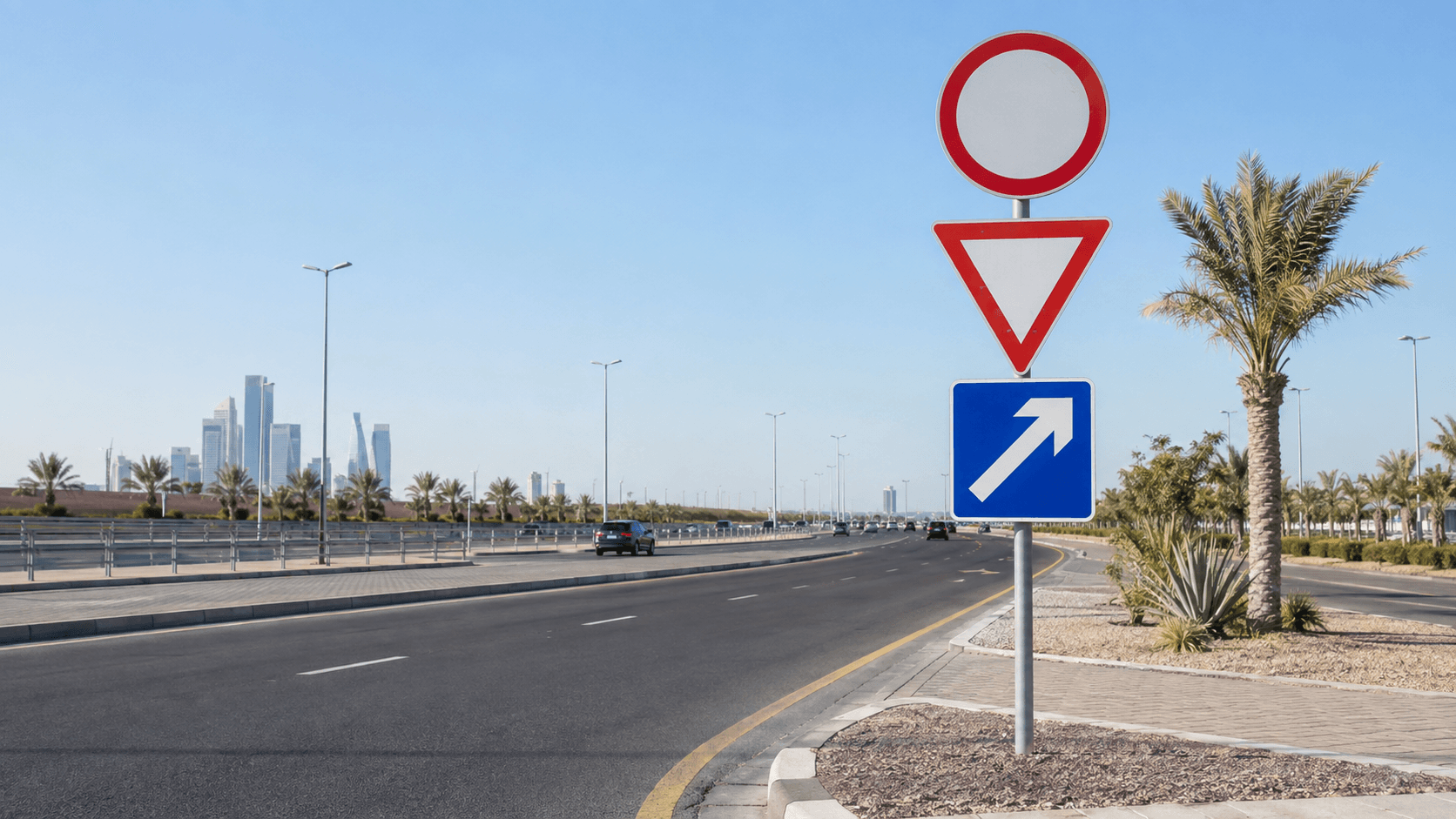
Traffic signs are a core part of a road’s operational infrastructure, not an item to be added at the end of a project. They provide clear instructions to road users, warn of potential hazards and support efficient movement on public roads, at facility entrances, in parking areas and through temporary work zones.
An effective sign system must align with the site’s engineering design, traffic volume, user profile, operating speeds and applicable authority requirements. Signs should therefore be treated as an integrated element alongside pavement markings, road studs, pedestrian routes and traffic-management systems.
Why Traffic Signs Matter in Infrastructure Projects
Traffic signs serve a direct purpose: delivering the right information, in the right place, when a driver or road user needs it. When signs are clear, visible and consistent with the traffic layout, they reduce hesitation at decision points and improve the management of routes, entries and exits.
Their role is not limited to highways and major streets. It also extends to industrial complexes, hospitals, airports, schools, development sites, parking facilities and construction areas.
Main Types of Traffic Signs
Regulatory and Mandatory Signs
Regulatory signs communicate the rules governing the use of a road or lane. These can include speed limits, no-parking instructions, no-entry restrictions, mandatory directions and limitations on turning or overtaking.
They are commonly used at:
Road and facility entrances and exits.
Intersections, merging areas and diversions.
One-way routes.
Parking facilities, loading zones and service areas.
Locations requiring clear control of vehicle or pedestrian movement.
This group also includes priority signs that manage right-of-way at intersections and conflict points, helping all road users make clear and safe decisions.
Warning Signs
Warning signs alert road users to changes in road alignment, potential hazards or conditions that require lower speeds and greater attention. They may warn of curves, gradients, intersections, pedestrian crossings, school zones, roadworks or surface changes.
These signs are particularly important where a hazard may not be immediately visible or where drivers need sufficient time to adjust their speed and lane position. They should be installed in advance of the hazard in accordance with the approved design and site conditions.
Guide and Information Signs
Guide signs help road users reach their destination and select the correct route without confusion. They commonly provide directions, road or area names, exit information, facility locations, parking guidance, pedestrian routes and service information.
They are widely used in:
Urban roads and large-scale developments.
Industrial and logistics complexes.
Parking facilities with multiple access points.
High-visitor facilities.
Airports, hospitals, universities and public facilities.
Their effectiveness depends on clear sequencing rather than excessive information. The required information should appear before a decision point and be repeated only where it helps confirm the route.
Work-Zone and Temporary Diversion Signs
These signs are used during maintenance, development works or temporary traffic diversions. Their role is to alert road users to a change from normal operating conditions and guide them safely through or around the work area.
A temporary traffic-management system may include advance-warning signs, speed-reduction signs where required, alternative-route signs and supporting elements such as cones, barriers, warning devices and temporary pavement markings.
These signs must be updated as work phases change. A temporary sign that no longer reflects the actual road condition can create confusion and reduce compliance.
Electronic and Variable Message Signs
Electronic or variable message signs display information that can be updated, including operational alerts, diversions, lane closures, congestion conditions and safety messages.
They are particularly suitable for high-volume or changing traffic conditions, primary corridors, city approaches and projects requiring ongoing operational management. They complement permanent signs rather than replacing the essential fixed signs used for permanent rules and directions.
Traffic-Sign Uses by Project Type
Project type | Practical use of traffic signs | Operational priority |
Roads and streets | Managing speeds, directions, intersections and exits | Clear decisions before conflict points |
Parking facilities | Guiding entries, exits, circulation routes and designated spaces | Reducing conflicts and random vehicle circulation |
Industrial complexes | Separating trucks, vehicles, pedestrians and loading areas | Improving internal operational safety |
Public facilities | Directing visitors to entrances, services and emergency exits | Accessible, understandable movement |
Work zones | Providing advance warning, diversion guidance and worker protection | Reducing risk during implementation |
Development projects | Organising internal routes and connections to facilities | A structured and scalable access experience |
How Are the Right Signs Selected for a Project?
A sign system should not be developed by selecting individual signs in isolation. It requires an integrated review of vehicle and pedestrian movement, access routes and conflict points. The process identifies the information users need before reaching a decision point, then determines the sign type, location, size and support arrangement in accordance with approved drawings and requirements.
Site Type and User Profile
Sign design differs between a public road, parking facility, industrial site and visitor-focused facility. A location with frequent truck movements requires route guidance and separation measures that differ from a site dominated by pedestrians or private vehicles.
Operating Speed and Sight Distance
Higher operating speeds require warnings and guidance to be provided earlier and with greater clarity. Signs should be readable from an appropriate distance, remain free from visual obstruction and avoid excessive competing messages.
Integration with Other Safety Elements
Signs achieve the best outcome when they work alongside pavement markings, solar road studs, barriers, pedestrian crossings and site lighting. A directional sign alone is not sufficient if the pavement route is unclear, and a work-zone warning should be supported by suitable separation and warning measures.
Compliance with Approved Design and Requirements
Sign content, location, retroreflective material, dimensions and mounting must comply with approved engineering drawings and the requirements of the relevant owner or regulatory authority. A single specification should not be assumed for every location, as requirements vary by road type, supervising authority and project conditions.
Common Errors That Reduce Sign Effectiveness
Common errors include placing signs after the decision point, using long messages that cannot be read while driving, repeating similar signs unnecessarily and failing to update temporary diversion signs as work phases change.
Poor coordination between signs and pavement markings can also create conflicting instructions. A full review of the safety system before operational handover helps ensure that the traffic message is consistent and clear throughout the site.
Traffic Signs as Part of an Integrated Safety System
Effective traffic signs are not measured by quantity, but by their ability to guide users with minimum hesitation and ambiguity. In infrastructure projects, good sign design links wayfinding with safer movement and turns an unstructured circulation area into a clear, manageable operating environment.
When publishing, this article can be internally linked to Traffic Safety Signs, Parking Marking Solutions and Solar Road Studs to help readers understand the connected elements of a complete traffic-safety system.
For technical planning of a sign system within a road, facility or work-zone project, contact Safety Triangle Contracting Co. to discuss the site requirements and appropriate solution scope.
Frequently Asked Questions
What is the difference between regulatory and warning signs?
Regulatory signs communicate rules that must be followed, such as mandatory direction or no-parking restrictions. Warning signs alert users to a hazard or road condition that requires greater attention or lower speed.
Where should guide signs be installed within a project?
They should be placed before decision points such as intersections, exits and entrances, then repeated where necessary to confirm the route. The exact location depends on the traffic layout, operating speed and sight distance.
Do parking facilities need traffic signs?
Yes. Parking signs manage circulation direction, identify entries and exits, indicate designated spaces and services, and can help separate vehicle and pedestrian movements where needed.
Why are signs important in temporary work zones?
They inform drivers that normal road conditions have changed and provide advance notice of roadworks, diversions or lane closures, supporting the safety of both road users and on-site workers.
Can electronic signs replace permanent signs?
No. Electronic signs are appropriate for changing information and operational alerts, while permanent signs remain necessary for fixed rules and ongoing directional guidance.
