

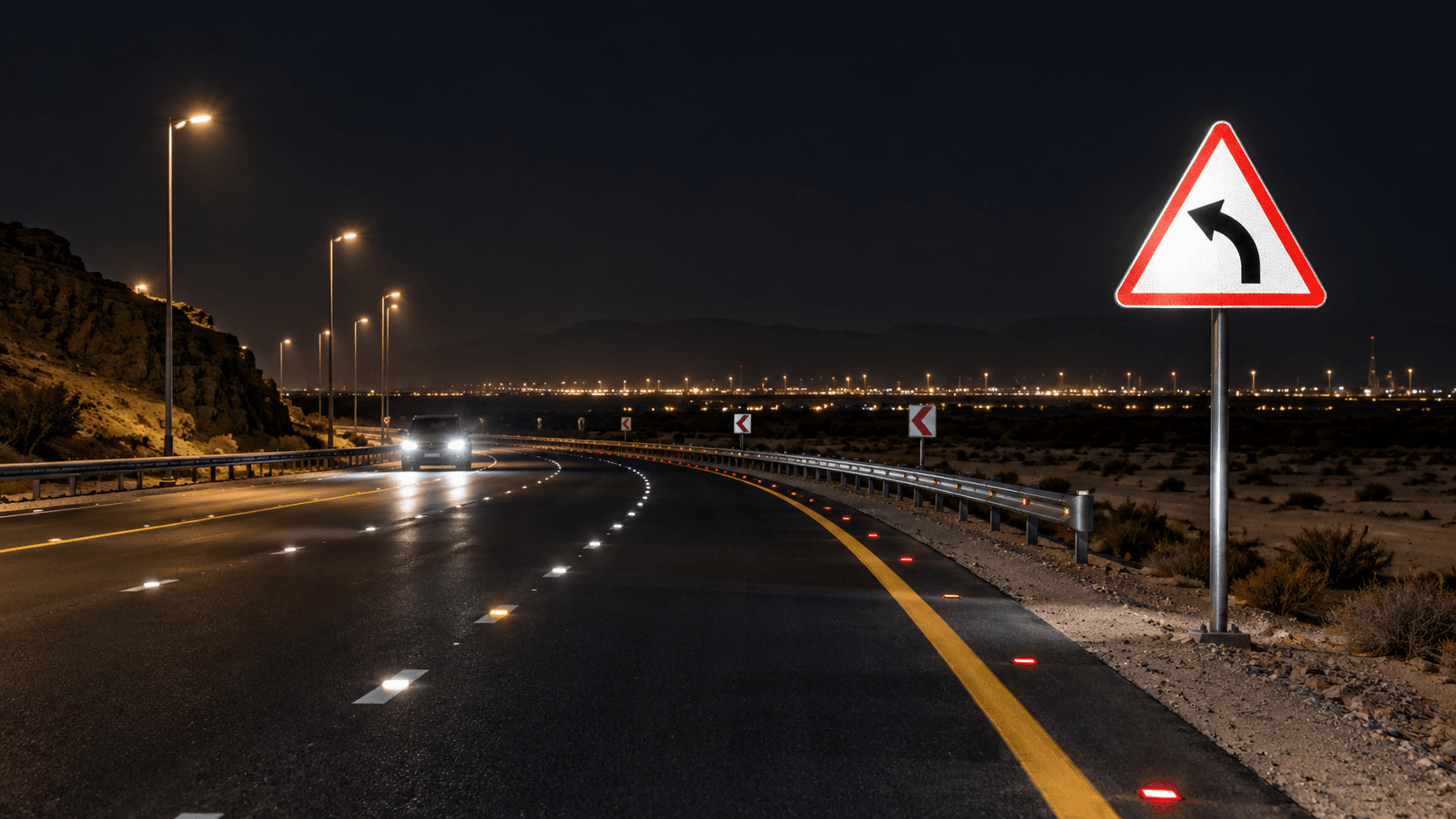
Traffic signs operate under changing conditions of light, speed, weather, and viewing distance. A sign that appears perfectly clear during the day may not provide the same level of visibility after dark.
At night, many traffic signs depend on retroreflective materials that redirect a portion of vehicle headlamp light back toward the driver, making the sign face, symbols, and message easier to detect and read during approach.
However, simply applying reflective material to a sign does not guarantee adequate night-time performance. The result depends on material selection, retroreflectivity, colour, viewing geometry, manufacturing quality, installation, environmental exposure, contamination, ageing, and maintenance.
Retroreflectivity should therefore be treated as part of the engineering performance of a traffic sign, not merely as a material feature.
What Are Reflective Materials in Traffic Signs?
Traffic signs commonly use specially engineered sheeting designed to redirect incoming light approximately back toward its source. This optical behaviour is known as retroreflection.
In a traffic environment, vehicle headlights illuminate the sign face. The retroreflective material then returns part of that light in the direction of the approaching vehicle, helping the driver identify the sign and interpret its message.
This differs from ordinary reflection from a shiny surface. For traffic applications, the objective is not simply to reflect light, but to return an appropriate amount of light toward road users.
Why Is Retroreflectivity Important for Night-Time Visibility?
A traffic sign is an engineering communication device. Its message must pass through several stages:
The driver detects the sign.
The sign shape and colour are recognised.
The symbol or wording is read.
The message is understood.
A decision is made.
The required manoeuvre is completed before the relevant hazard or decision point.
If a sign is detected too late or cannot be read clearly, the driver has less distance and time available to respond.
Night-time performance is particularly important on:
Higher-speed roads.
Poorly illuminated routes.
Intersections, entrances, and exits.
Curves and warning locations.
Work zones and temporary diversions.
Industrial and remote roads.
Parking ramps and internal circulation routes.
Locations exposed to dust or changing visibility conditions.
For this reason, daytime appearance alone is not an adequate measure of traffic-sign performance.
How Do Retroreflective Materials Work?
Traffic-safety materials use microscopic optical structures designed to return incoming light toward its source.
Glass-Bead-Based Materials
Some retroreflective systems use small glass optical elements that manipulate incoming light and redirect it toward the illumination source.
This technology has been widely used in traffic-safety applications.
Microprismatic Materials
Other materials use precisely engineered microprismatic structures to control the path of light and achieve retroreflective performance.
Material technology alone, however, should not determine product selection. The required performance must be consistent with the approved project specification, road environment, sign function, and actual viewing conditions.
How Is Traffic-Sign Retroreflective Quality Evaluated?
Calling a product “reflective” or “highly reflective” is not sufficient for technical assessment.
Coefficient of Retroreflection
The coefficient of retroreflection is used to characterize how effectively a material returns light under defined measurement geometry.
Results depend on factors including:
Entrance angle.
Observation angle.
Material colour.
Optical construction of the sheeting.
A numerical result therefore should not be evaluated independently of its testing geometry and applicable specification.
Entrance and Observation Geometry
A material may perform strongly under one geometry but behave differently when a sign is mounted high above the road, placed laterally, or viewed from a different approach angle.
This is especially relevant to:
Overhead signs.
Multi-lane roads.
Curved approaches.
Side-mounted signs.
Parking facilities with changing vehicle paths.
Colour and Contrast
Night-time legibility depends on more than brightness.
Clear contrast must be maintained between:
Background and legend.
Background and symbol.
Borders and other sign elements.
A very bright sign with poor visual contrast can still be difficult to read.
Is the Highest Retroreflectivity Grade Always the Best Choice?
No.
Selecting the highest available retroreflectivity level is not automatically the correct engineering decision for every traffic sign.
Selection depends on:
Road classification.
Approach speed.
Sign function.
Required detection and reading distance.
Ambient lighting.
Sign position and mounting height.
Viewing geometry.
Importance of the message.
Client requirements.
Approved project drawings and specifications.
The objective is not simply to maximise reflected light. It is to provide appropriate and consistent visibility for the application.
For the broader selection process, this topic is closely related to our guide on how to choose the right traffic signs for road and parking projects.
What Determines Reflective Sheeting Quality Beyond Brightness?
Initial retroreflectivity is only one aspect of quality.
Adhesion to the Sign Substrate
The sheeting should remain properly bonded to the sign face without peeling, separation, or blistering that could affect appearance and performance.
Printing and Colour Quality
Printing, legends, symbols, and other applied elements should maintain the visual properties required by the project specification.
Environmental Resistance
Outdoor signs may be exposed to:
Solar radiation and ultraviolet exposure.
High temperatures.
Dust and sand.
Humidity.
Rain.
Coastal salinity.
Cleaning and maintenance operations.
Materials should therefore be evaluated according to the required service conditions rather than their appearance at the time of delivery alone.
Surface Uniformity
Visible variations in brightness or reflection across the same sign can indicate manufacturing, application, contamination, or damage issues.
The finished sign should present a visually consistent surface in accordance with its approved design and specification.
How Does Sign Colour Affect Night-Time Performance?
Traffic-sign colours are functional rather than purely decorative.
Different colours have different optical properties, and their expected retroreflective responses are not identical.
This means that two different colours should not be judged simply by asking which appears brighter.
It is also important not to modify standardized regulatory or warning sign colours merely to match a facility's corporate identity, as doing so may reduce rapid recognition of the traffic message.
High-Quality Sheeting Alone Does Not Guarantee a Visible Sign
A sign may use a high-quality retroreflective material and still perform poorly in the field.
Incorrect Installation Angle
The orientation of the sign face relative to approaching vehicles affects the amount of light returned toward the driver.
Sign orientation should therefore respond to the actual direction of approach.
Incorrect Location
Even excellent retroreflective sheeting cannot compensate for a sign that is:
Hidden by vegetation or structures.
Obstructed by vehicles.
Installed after the decision point.
Excessively offset from the driver’s path.
Visually competing with other signs.
Inadequate Sign Size
Detection and legibility are not the same.
A driver may notice a bright sign ahead but still be unable to read the message in time if the letters, symbols, or overall sign size are inadequate for the operating speed and viewing distance.
Excessive Information
Increasing retroreflectivity cannot correct a sign containing too much information.
Messages should remain concise and arranged according to the decisions road users need to make.
How Should Reflective Materials Be Inspected Before Sign Approval?
Quality control begins before installation.
First: Review the Specification
Confirm that the proposed material complies with the requirements stated in:
Project documents.
Drawings.
Sign schedules.
Client requirements.
Applicable standards and specifications adopted for the project.
A specified material should not be substituted solely because another product appears visually similar.
Second: Review Material Documentation
Technical documentation should be reviewed against the approved project requirements.
Third: Inspect Manufacturing Quality
Check for:
Surface damage.
Blistering or peeling.
Colour consistency.
Clean cuts and edges.
Accurate symbols and legends.
Scratches.
Uniform application of reflective materials.
Fourth: Inspect the Finished Sign
The final sign—not only the raw sheeting—is the product that will operate on the road.
Quality control should therefore consider how the reflective sheeting, printing, colours, symbols, dimensions, and finishing work together.
Why Is a Night-Time Inspection Necessary After Installation?
Daytime inspection is important, but it cannot fully assess the performance for which retroreflective sheeting is designed.
Signs should be reviewed at night from the actual vehicle approach path.
The review should consider:
When the sign first becomes detectable.
Recognition of shape and colour.
Message legibility.
Uniformity of retroreflection.
Dark areas.
Excessive glare.
Viewing angle.
Obstructions and competing light sources.
The objective is not to make a sign appear as bright as possible. It is to ensure that the message remains clear and usable at the correct point in the driving task.
What Causes Retroreflective Performance to Decline?
Several factors may reduce sign performance during service.
Dust and Contamination
A layer of dust or dirt can reduce the amount of light reaching and returning from the retroreflective surface.
This is particularly relevant on exposed roads and industrial sites.
Scratching and Surface Damage
Impact, abrasion, or unsuitable cleaning practices can damage the reflective face.
Environmental Ageing
Long-term exposure to sunlight, heat, humidity, and weather can gradually affect material performance.
Localised Sign Damage
A sign can become functionally deficient even when most of its surface remains intact.
Damage to an important arrow, symbol, number, or word can have a greater operational effect than a small uniform reduction across the rest of the panel.
When Should a Traffic Sign Be Cleaned, Maintained, or Replaced?
Replacement decisions should not depend solely on the age of the sign.
Condition should be reviewed when there is:
Noticeable reduction in night-time visibility.
Colour fading.
Loss of contrast.
Peeling or damaged sheeting.
Significant scratching.
A bent or distorted sign face.
Missing parts of the traffic message.
Changes to traffic circulation that make the sign location obsolete.
Failure to meet project requirements or asset-management criteria.
A planned inspection and maintenance programme is preferable to waiting until poor sign visibility becomes an operational problem.
Retroreflective Signs Are Part of an Integrated Night-Time Visibility System
Traffic signs do not operate independently from the rest of the roadway.
Integration with Pavement Markings
Arrows and directions on signs should correspond with pavement arrows, lane lines, and other road markings.
Many road-marking systems also incorporate reflective elements to help delineate lanes and traffic information at night.
Integration with Road Studs
Road studs and pavement reflectors can help drivers understand road geometry and maintain lane guidance between successive signs.
In some applications, solar road studs provide active illumination rather than relying solely on reflected headlamp light, making their operating principle different from passive retroreflective traffic signs.
Integration with Roadway Lighting
Street lighting does not automatically eliminate the need for suitable retroreflective performance.
In addition, bright commercial lighting and other illuminated objects can create visual competition, so signs must be evaluated within their actual operational environment.
Common Mistakes When Procuring Reflective Traffic Signs
Selecting Materials Based Only on Price
Price alone does not establish whether a material is technically appropriate for a given project.
Using One Specification for Every Sign
A high-speed warning sign and an internal low-speed parking sign do not necessarily have identical performance requirements.
Relying on Marketing Terms Such as “High Reflective”
Generic commercial descriptions are not substitutes for a defined material classification, specification, and technical documentation.
Assessing Samples Only Indoors
Office lighting does not reproduce the night-time geometry of a road environment.
Ignoring Installation Geometry
An approved material and correctly manufactured sign can still underperform if it is installed at an unsuitable angle.
Skipping Night-Time Inspection
Problems involving poor retroreflection, glare, or legibility may remain undetected until the road or facility becomes operational.
Ignoring Maintenance Requirements
Even correctly manufactured signs require inspection, cleaning, and condition monitoring throughout their service life.
Reflective Traffic Sign Quality Checklist
Before approving or accepting traffic signs, confirm:
Is the required reflective material defined in the project specification?
Is it suitable for the road type and sign function?
Does the technical documentation correspond with the approved material?
Are the colours and symbols correct?
Is the reflective surface uniform and free from defects?
Are printing, cutting, and finishing acceptable?
Are the sign and legend dimensions appropriate for viewing distance?
Is the sign clearly visible from the approach direction?
Is the installation angle appropriate?
Are there vegetation, structures, or vehicles obstructing visibility?
Has the sign been evaluated at night?
Does the message remain clear without dark areas or inappropriate glare?
Is there a plan for inspection, cleaning, maintenance, and replacement?
How Do You Select the Right Reflective Traffic Sign for a Project?
The correct decision begins with the project, not the material catalogue.
First establish:
Road or facility type.
Vehicle speed and direction of travel.
Sign function and importance.
Required viewing distance.
Ambient lighting conditions.
Expected viewing geometry.
Environmental exposure.
Applicable project specifications and approvals.
Inspection and maintenance requirements.
The appropriate traffic-sign and retroreflective material system can then be selected based on those conditions.
Professional traffic-sign procurement should therefore begin with site requirements and engineering specifications, rather than selecting a generic sign by appearance or price.
Conclusion
Retroreflective materials are fundamental to the night-time performance of traffic signs, but sign quality cannot be reduced to the brightness of the sheeting alone.
Effective performance results from the combination of appropriate retroreflective material, sign design, contrast, dimensions, location, installation angle, night-time inspection, and ongoing maintenance.
For road, parking, and infrastructure projects, this integrated approach helps ensure that traffic signs remain detectable, legible, and useful at the moment drivers need to make a decision.
Safety Triangle Contracting Co. provides traffic-safety and traffic-sign solutions for road and infrastructure projects, with an engineering approach focused on matching each solution to site conditions and approved project requirements.
Frequently Asked Questions
What are reflective materials used on traffic signs?
They are materials designed to return a portion of vehicle-headlamp light toward the driver, improving the visibility of traffic signs, symbols, and legends at night and under low-light conditions.
What is the difference between reflection and retroreflection?
Ordinary reflection may redirect light away from its source depending on surface geometry. Retroreflection is engineered to return light approximately toward its source, making it particularly useful for night-time traffic applications.
Is the highest retroreflectivity level best for every traffic sign?
No. The appropriate level depends on road type, speed, sign function, viewing geometry, ambient lighting, and the approved requirements of the project.
How can traffic-sign night-time performance be checked?
Signs can be evaluated through routine condition inspection, night-time review from actual vehicle approach directions, and technical measurements where required by project specifications or asset-management procedures.
Can dust reduce traffic-sign retroreflectivity?
Yes. Dust and surface contamination can reduce optical performance, making cleaning and inspection particularly important in environments exposed to sand and airborne contamination.
Does street lighting eliminate the need for retroreflective traffic signs?
Not necessarily. Sign requirements depend on the roadway design, operational environment, and applicable project specifications. Lighting levels can also change or fail, so sign performance should be assessed as part of the overall traffic-safety system.
